
'We were in a heavily nuclearised environment. China had tested for Pakistan in the 1980s and helped their missile programme stay just one step behind us.'

Australia, home to the world's largest uranium reserves, could drop its ban on selling the yellowcake to India after a panel commissioned by Prime Minister Kevin Rudd and his Japanese counterpart Yukio Hotoyama recommended changes to the nuclear non-proliferation regime.
An international commission on disarmament has recognised that India will not sign Non Proliferation Treaty, but has disappointed it by clubbing it with Pakistan and Israel in terms of non-proliferation and disarmament obligations.
For the first time, representatives from India and Pakistan have been invited to the meeting of the newly constituted International Nuclear Disarmament Commission, which is working towards rectifying the NPT to make it more acceptable.
Although the credit for acquiring the technological skill must be given to India's outstanding nuclear scientists, the decision to go nuclear was a political one that entailed clarity of vision, courage and resolve, points out Rup Narayan Das.
The scientists, who met the chairman of the Atomic Energy Commission, also said that India has been asked to participate in the international efforts on nuclear non-proliferation, with a policy that is congruent to that of the US.

'India has to think about modulating its position on Iran,' says US Congressman and India ally Gary Ackerman.

The study titled 'Indian Unsafeguarded Nuclear Program' published by the Institute of Strategic Studies Islamabad is co-authored by four nuclear scholars, including Adeela Azam, Ahmed Khan, Mohammad Ali and Sameer Khan.

Vajpayee had always felt that India must act with conviction and panache. He decided that, irrespective of the attendant risks, he would undertake what many felt was a precarious course. A fascinating excerpt from N K Singh's Portraits Of Power: Half A Century Of Being At Ringside on Atalji's 96th birthday, December 25.

We have nothing to gain by raising our concerns internationally as our narrative has got entangled with several controversial concepts in the United Nations, asserts Ambassador T N Sreenivasan.
Russia also welcomed the separation plan of military and civilian nuclear programmes and India's compliance with non-proliferation norms.

Chinese foreign ministry spokesperson, Hua Chunying said China-Pakistan cooperation is in accordance with the 48-member nuclear club, which supervises global nuclear commerce.

Immediate NSG membership will not help India realise its nuclear ambitions any faster. It could have easily left the process take its own course, instead of running a high-stakes campaign to get in, says B S Raghavan.
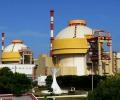
'Decisions on nuclear power have so far been taken by a small select group, primarily interested in profiteering from their actions, stating 'secrecy' as necessary from the national security point.' 'This argument is false, because we are dealing with the 'civilian' nuclear power sector, which is open even to the IAEA,' says Dr A Gopalakrishnan, former chairman of the Atomic Energy Regulatory Board.

At a joint media briefing with Lavrov, Jaishankar listed issues such as "factors of instability" such as terrorism and its cross-border manifestation and said it remains a "major concern".

20 years ago this day, May 11, 1998, India conducted its second nuclear test at Pokharan in Rajasthan. In a fascinating interview on Rediff.com, K Subrahmanyam revealed how Indian PMs reacted to nuclear ambitions.

'When economic policies were attacked by people on his own side, he went ahead despite all the criticisms in the coalition, within the party and the Sangh Parivar.'
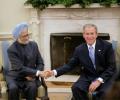
In the mid-1980s, India and the US struggled to arrive at sufficient confidence for Washington to even sell a supercomputer to India for monsoon prospecting. Now, the most sensitive military technologies, data, and intelligence resources are being shared. This would not have happened without that one, big deal that changed the fundamentals of India-US relations, notes Shekhar Gupta.

India has built two top-secret facilities in Karnataka to enrich uranium in pursuit of its hydrogen bomb dream.
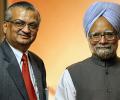
'Dr Singh, visibly relieved, said, 'Yesterday night I couldn't sleep. I stayed awake, praying throughout. You have saved the country'.' A fascinating excerpt from former atomic energy chief Dr Anil Kakodkar's memoir Fire And Fury: Transforming India's Strategic Identity.
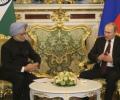
In a clear attempt to allay Russia's apprehensions, Prime Minister Manmohan Singh on Monday said it will remain an "indispensable" partner for India's defence needs even as he underlined that the bilateral ties should adapt to changing times to address challenges.

'With the recent challenging of the notion of the Indian Ocean Region being India's strategic backyard, China is gradually upping the ante in the maritime realm around India.'

This is the joint statement issued by the ministry of external affairs on the visit of US President Barack Obama to India.
